
The bunk is the bed nobody plans for. You buy twin sheets because a bunk looks like a small single, and by the second night the fitted sheet has pulled off the corner by the wall, the spare fabric has rolled into a ridge down the middle, and whoever sleeps up top has given up and is lying on the bare mattress.
It is not the sheets’ fault. An RV or camper bunk is cut to fit a gap in the vehicle, and there is no such thing as a standard bunk. Two bunks in the same trailer are often different sizes, and one of them may have a corner clipped off to clear a door. A twin sheet was designed for a household bed that is wider, usually deeper, and always square.
This guide covers the bunk sizes you are likely to find, why twin sheets fail on almost all of them, how to measure a bunk properly (including the angled ones), and how to get sheets that are cut to each bunk rather than to a size chart.
Why twin sheets never fit an RV bunk
A residential twin mattress is 38 inches wide and 75 inches long, and a twin XL is 38 by 80. RV bunks are almost always narrower than either, and they vary in length. That mismatch causes three separate problems, and most bunks have at least two of them.
- Too wide. On a 30-inch bunk a twin fitted sheet has 8 inches of spare width. The elastic has nothing to grip, so the fabric gathers under the sleeper.
- The wrong length. Some bunks are shorter than a twin and some are longer. On a 72-inch bunk the twin sheet is loose at the foot; on an 80-inch bunk it will not reach the corners at all.
- Too deep. Bunk mattresses are much thinner than a household mattress, while standard fitted sheets are cut with deep pockets. All that pocket fabric folds back under the mattress and works loose.
Then there is the corner. Many bunks, especially the top bunk in a travel trailer or a bunkhouse, have one corner cut at an angle to clear a door, a step or the curve of the wall. A rectangular sheet cannot follow that line, so that corner never stays on.
RV bunk sizes: what you are likely to find
Bunks are the least standardised beds in any vehicle. Most fall between 28 and 35 inches wide and 72 and 80 inches long, but manufacturers use their own dimensions, so treat the chart below as a way to recognise what you have, not as a size to order.
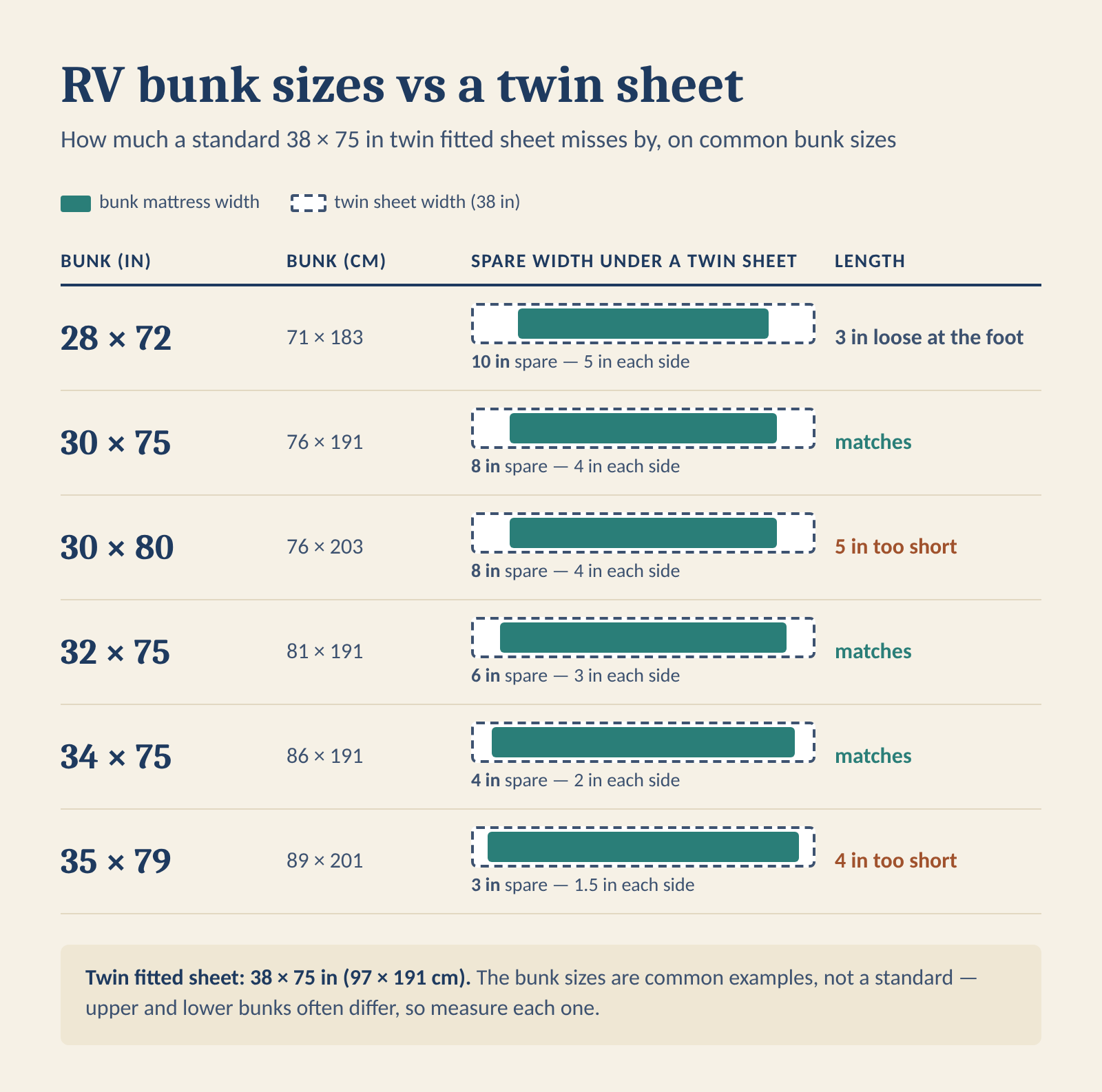
Two things in that chart are worth noticing. First, the spare width is never small: even a 34-inch bunk leaves 2 inches of loose fabric on each side under a twin sheet. Second, the longer bunks are the ones people get wrong most often, because a 79- or 80-inch bunk looks like a twin but needs a sheet longer than a twin.
Bunks with a cut corner
If one corner of your bunk is clipped at an angle, you are looking at the shape that searches like “camper bunk sheets angled” are trying to solve. Nothing sold in a standard size will fit it, and folding the spare fabric under is a nightly job that never quite works.
Our fitted sheets for boats and RVs start from the shape, not from a size. There are 14 predefined mattress shapes, including cut corners, angled sides and tapered foot ends, and each shape shows exactly which sides to measure. A bunk with one clipped corner is one of them, with the cut on either the left or the right corner. If your bunk matches none of them, upload a simple sketch with the measurements written on it: the tool reads the drawing, you confirm the dimensions, and the price is calculated automatically. There is no template kit to wait for in the mail and no quote to request.
One honest limit. Cotton has no stretch, so we make sheets with straight and angled edges, not curved ones. If your bunk has a fully curved side, contact us before ordering and we will tell you what is possible.
How to measure an RV bunk
Getting the numbers right is the whole job, and a bunk is awkward to measure because you usually cannot stand on all four sides of it. Take the mattress out if you can, or at least pull it away from the wall.
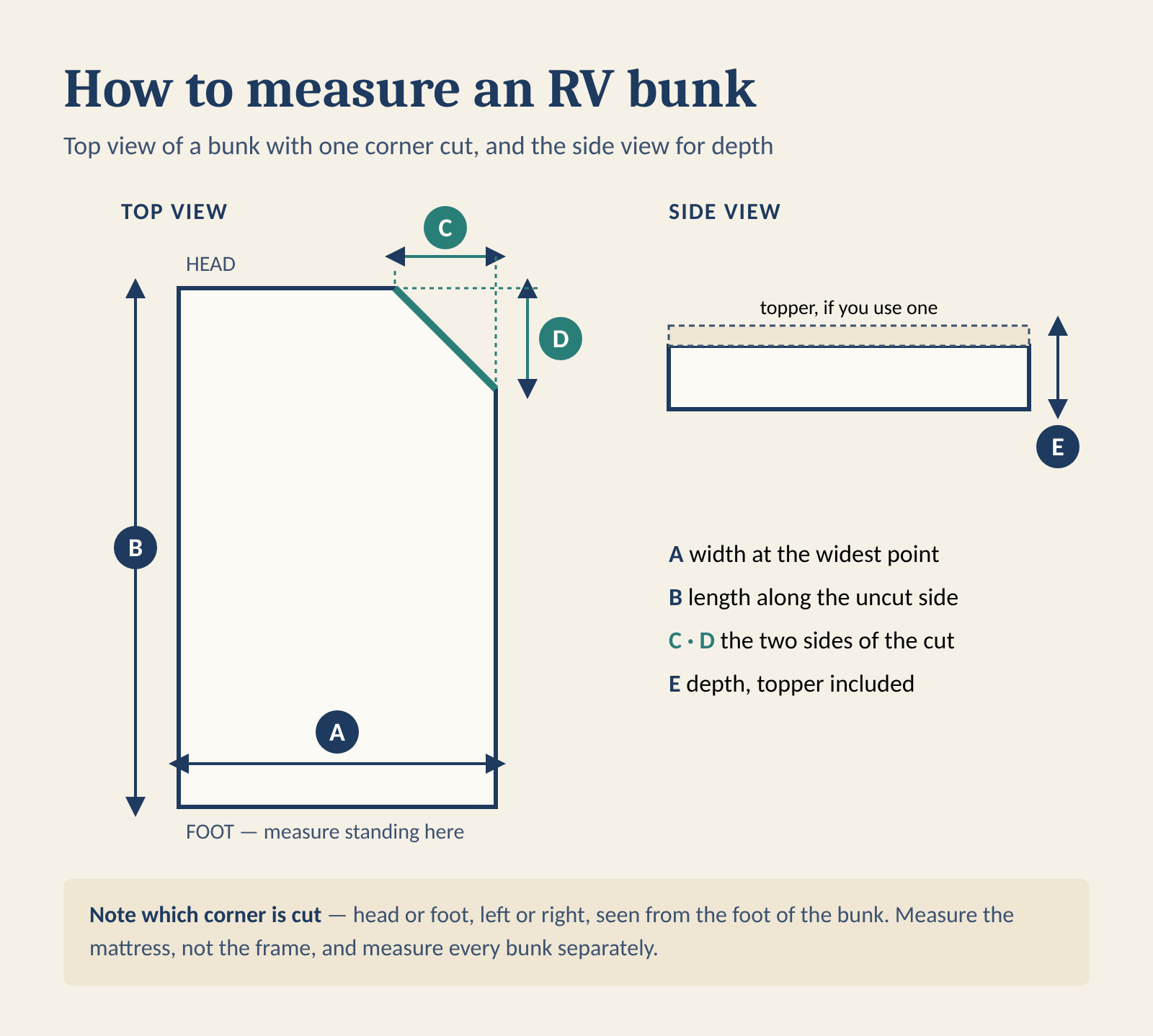
- Measure the mattress, not the bunk frame or an old sheet. Frames have trim and lips that the mattress does not, and old sheets shrink and stretch.
- Width and length at the widest and longest points. On a cut-corner bunk, measure the full length along the side that is not cut.
- The two sides of the cut. Measure how far the angle runs along the end and how far it runs along the side. Those two numbers define the corner.
- Note which corner is cut — head or foot, left or right, seen from standing at the foot of the bunk. A sheet with the angle on the wrong side will not fit.
- Depth, including any topper. A thin bunk mattress with a 2-inch topper is a different sheet from the mattress alone.
- Measure every bunk separately. Upper and lower bunks in the same RV are often different, and the cut corner is usually only on one of them.
If you would like the general version for rectangular beds, our measuring guide walks through it step by step.
Making a top bunk: why the elastic matters
A top bunk is made from a ladder, kneeling, with one long side against the wall. Most fitted sheets have elastic only at the corners, so the edge you cannot reach is the edge that works loose first, and on a mattress you cannot walk around you will not see it until it has pulled off.
Our fitted sheets have elastic all the way around the perimeter. On a bunk that means the wall side stays tucked under along its whole length, and a sheet cut to the exact size has no spare fabric to creep. You put it on once from the open side and it stays.
Top sheets and duvet covers for bunks
A fitted sheet is the piece that has to match the mattress exactly; the layers on top are more forgiving, but a bunk is still narrow enough that a twin top sheet hangs down into the bunk below or bunches against the wall.
Flat sheets are sold individually and made to the finished width and length you enter, so you decide how much tuck you want on a thin bunk mattress. Custom duvet covers are made to the size of your own comforter or duvet, whatever odd size you found to suit the bunk.
Which fabric for an RV bunk
Bunks are small, enclosed and often close to the ceiling, which is where the warm air in a camper collects. That makes breathability more important than it is in a bedroom.
- Cotton percale — crisp, cool and matte. The better choice for summer touring, top bunks and anyone who sleeps warm.
- Cotton sateen — smoother, softer and with more drape. Warmer to sleep under, and better for shoulder-season trips.
Percale comes in 200 to 800 thread count and sateen in 300 to 1000. Apart from Percale 200 TC, every fabric is woven and dyed in Italy, and every fabric is tested for shrinkage, colorfastness and consistency. The cottons are OEKO-TEX® certified, tested for harmful substances. Our comparison of percale and cotton sateen goes into the difference in more detail.
Frequently asked questions
What size sheets fit an RV bunk bed?
Usually none of the standard sizes. Most RV bunks are 28 to 35 inches wide, narrower than a 38-inch twin, and between 72 and 80 inches long. Measure your bunk’s width, length and depth and have the fitted sheet made to those numbers.
Will twin sheets work on a camper bunk?
They will go on, but they will not stay flat. On a 30-inch bunk a twin fitted sheet leaves 8 inches of spare width, and on a bunk longer than 75 inches it will not reach the corners.
Can you make sheets for an angled or cut-corner bunk?
Yes. Choose the cut-corner shape from the 14 predefined shapes — it comes with the cut on the left or the right corner — or upload a sketch with your measurements. The sheet is cut to that outline, with the angle on the side you specify.
My upper and lower bunks are different sizes. Is that a problem?
Not at all — it is normal. Measure each bunk separately and order a sheet for each one. Every sheet is made to its own dimensions.
Do I need to request a quote?
No. The price is calculated as you enter your dimensions, for any size and any shape, including sketched ones.
What about the main bed?
The same problem applies to RV short queens and RV kings. Our RV bedding guide covers the main bed sizes and the European caravan layouts.
Get sheets cut to each bunk
Choose the bunk’s shape or upload a sketch, enter its measurements, pick your fabric and color, and the price appears instantly. Do the same for the next bunk. No template kit, no quote request, no waiting.