

The fitted sheet went on without a fight. Then you shook out the flat sheet, and it stopped about eight inches short of where it needed to be. Not dramatically wrong — just wrong enough that there is nothing to tuck on one side, and by morning the whole thing has migrated.
This is the most common complaint we hear about oversized beds, and it is not really a quality problem. It is an arithmetic problem, and almost nobody publishes the arithmetic. So here it is: what the standard flat sheet sizes actually are in inches, what they cover once your mattress depth is taken into account, how to work out the two numbers you actually want, and the one real limit on how wide a flat sheet can be made.
Why a flat sheet that is the right size still does not fit
A fitted sheet is made from your mattress: width, length, depth. Three numbers, and the elastic does the rest. A flat sheet is not made from your mattress at all. It is a plain rectangle that has to be bigger than the bed by however much you want hanging over each side — and the amount you want hanging over depends on how deep your mattress is, which is the one number nobody in the industry assumes correctly.
When the standard sizes were settled, a mattress was around 9 inches deep. A pillow-top or hybrid today is routinely 14 to 18 inches, and that difference comes off both sides of the sheet. A king flat sheet at 108 × 102 in gives you 16 inches of overhang per side on a 14-inch mattress. Sixteen inches covers the depth and leaves two inches to tuck, which is not enough to hold overnight. Nothing is defective. The sheet was designed for a thinner bed.
Go up to a Wyoming, Texas or Alaskan king and the problem stops being about tuck and starts being about coverage: there is no standard flat sheet size for those beds at all.
Flat sheet sizes in inches — the full chart
These are the US trade conventions. Individual brands drift an inch or two either way, which is itself worth knowing when you are replacing a sheet that used to fit.
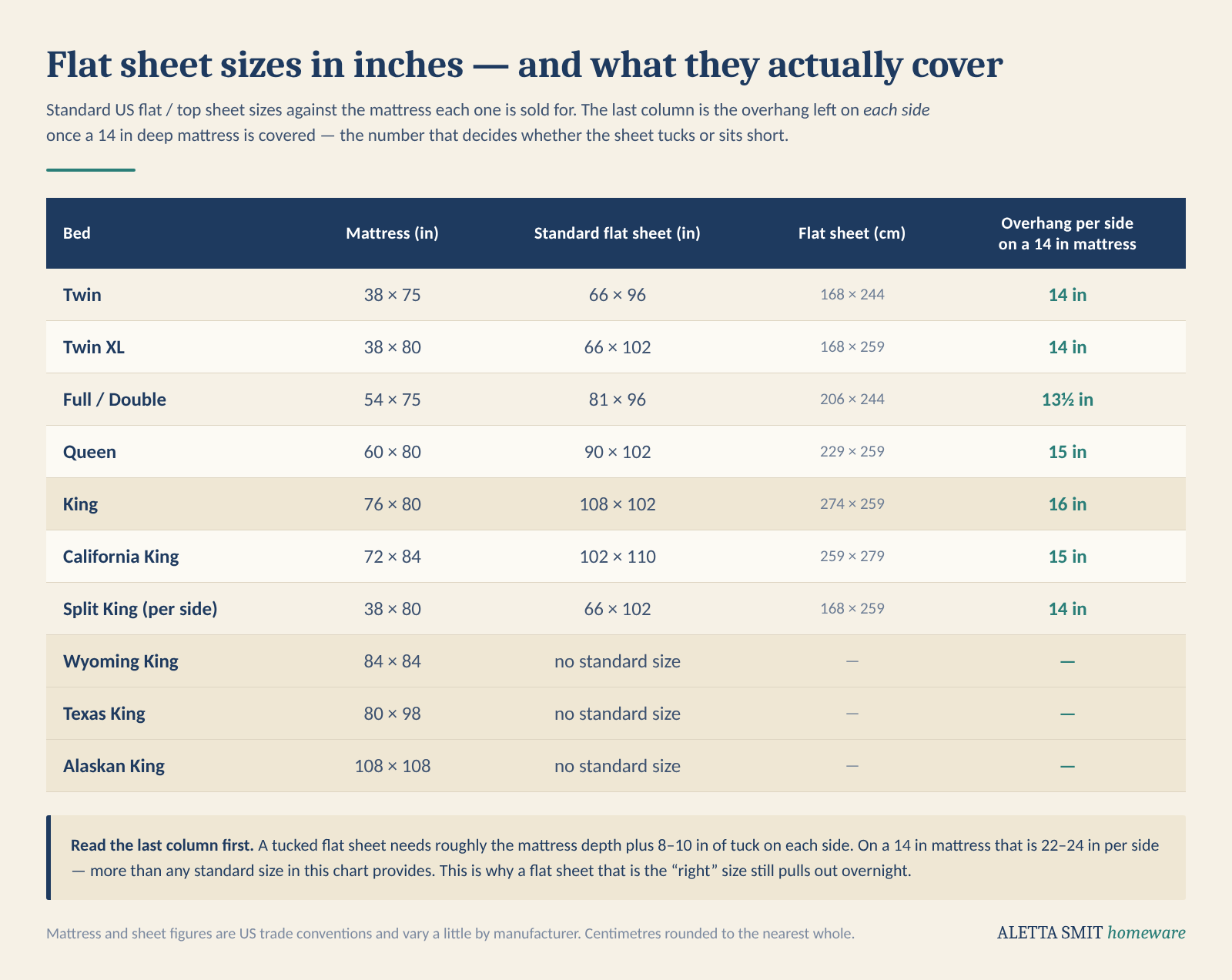
| Bed | Mattress (in) | Standard flat sheet (in) | Flat sheet (cm) |
|---|---|---|---|
| Twin | 38 × 75 | 66 × 96 | 168 × 244 |
| Twin XL | 38 × 80 | 66 × 102 | 168 × 259 |
| Full / Double | 54 × 75 | 81 × 96 | 206 × 244 |
| Queen | 60 × 80 | 90 × 102 | 229 × 259 |
| King | 76 × 80 | 108 × 102 | 274 × 259 |
| California King | 72 × 84 | 102 × 110 | 259 × 279 |
| Split King (per side) | 38 × 80 | 66 × 102 | 168 × 259 |
| Wyoming King | 84 × 84 | no standard size | — |
| Texas King | 80 × 98 | no standard size | — |
| Alaskan King | 108 × 108 | no standard size | — |
How to work out your own two numbers
Ordering a custom flat sheet means giving the finished size of the sheet itself, not your mattress size. That trips people up, so here is the calculation in full.
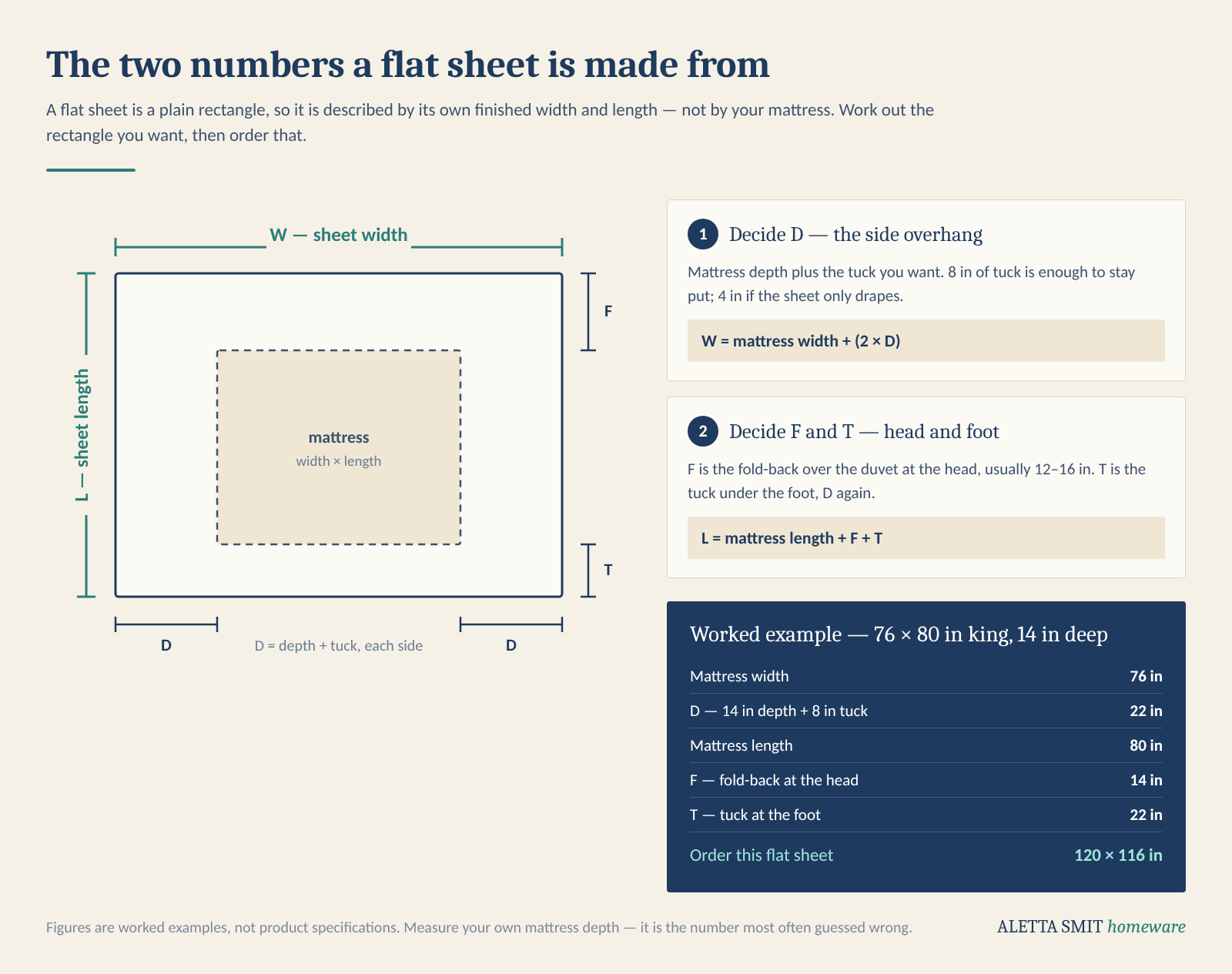
Width. Measure your mattress across, then decide what you want hanging over each side. For a sheet that stays tucked, that is your mattress depth plus about 8 inches. For a sheet that simply drapes — no tuck, the way most made beds now look — 4 to 6 inches past the depth is plenty.
Sheet width = mattress width + (2 × overhang)
Length. Your mattress length, plus the fold-back at the head that sits over the duvet (12 to 16 inches looks right), plus the tuck at the foot — the same figure you used for the sides.
Sheet length = mattress length + fold-back + foot tuck
A standard 76 × 80 in king at 14 inches deep, tucked properly, comes out at 120 × 116 in. Compare that with the 108 × 102 in you can buy off the shelf and you can see exactly where the missing eight inches went.
Measure your mattress depth with the mattress protector and topper on, if you use them. Depth is the number people guess, and it is the number that decides everything else.
The one real limit: 116 inches across
Our cloth is woven 305 cm wide. After the allowance we build in for shrinkage in the wash, and after hemming, the usable width is 295 cm — 116 inches. So one of your two finished measurements has to be 116 inches or less. The other can be as long as you need it.
In practice that is less restrictive than it sounds, because a flat sheet is a rectangle and the limit applies to whichever of the two numbers is smaller. A sheet of 120 × 116 in is fine. So is 150 × 116. What is not possible is 120 × 120, where both sides exceed a single width of cloth.
One case worth knowing before you order: an Alaskan king is 108 inches wide, so a flat sheet at the full 116 inches leaves about four inches over each side — enough to cover the mattress, not enough to tuck under it. If a tucked top sheet matters to you on a bed that wide, get in touch before ordering and we will tell you what is possible.
This limit is specific to flat sheets and duvet covers, which are flat panels. It does not apply to fitted sheets, where panels are joined where needed — no mattress is too wide for a fitted sheet. People ordering a sheet set are often surprised by this, so it is worth stating: in a set, the fitted sheet has no width limit and the flat sheet does.
Buying a flat sheet on its own
A good many people arrive here looking for one thing: a top sheet, by itself, in a size nobody sells. The fitted sheet is fine; it is the flat sheet that wore through, or went missing, or came in a set that never included one.
Flat sheets are sold individually here — you do not have to buy a set to replace one. The same applies in reverse if what you want is the full set: a fitted sheet with full-perimeter elastic, a flat sheet, and two reversible pillowcases with contrast stitching, all cut to your measurements.
If you measure in centimetres
The same arithmetic works unchanged; only the units move. A 180 × 200 cm bed at 35 cm deep, tucked, wants roughly 180 + (2 × 55) = 290 cm across and 200 + 38 + 55 = 293 cm long. Both are inside the 295 cm single width, which is why European sizes rarely run into the limit that American oversized beds do. UK and Australian beds behave the same way.
Fabrics
Flat sheets come in the same range as the rest of the bed: cotton percale in 200, 400, 500, 600 and 800 TC, and cotton sateen in 300, 600 and 1000 TC. Percale is the crisp, cool, matte one; sateen is the smooth, lightly lustrous one. Which to choose depends on how you sleep rather than on which is better.
Colour availability varies by quality: percale 200 and 500 TC and sateen 300 and 600 TC come in the full colour range; percale 400 and 600 TC in white and ivory; percale 800 TC and sateen 1000 TC in white only. Every fabric apart from percale 200 TC is woven and dyed in Italy, and all of them are tested for shrinkage, colourfastness and consistency. The cottons are OEKO-TEX® certified — tested for harmful substances. Each sheet is finished with decorative edge stitching.
Common questions
What size is an oversized king flat sheet?
There is no standard. Off the shelf, “oversized king” usually means something between 110 × 102 and 114 × 106 in — bigger than a king, not enough for a deep one. Made to measure, a 76 × 80 in king at 14 inches deep wants 120 × 116 in if you intend to tuck it.
Can I buy just the flat sheet without the fitted sheet?
Yes. Flat sheets are a product in their own right here, in any size you enter.
How wide can a flat sheet be?
One of its two finished measurements has to be 116 in (295 cm) or less, which is the usable width of the cloth. The other is effectively unlimited.
Do you make flat sheets for a round bed?
Not round ones — a top sheet is always rectangular, because it lies loose rather than gripping the mattress. Round fitted sheets are a different matter and follow the mattress shape exactly.
What about the duvet cover?
Same 116-inch rule, same reason. Oversized duvet cover sizes in inches covers that in detail.
Order the size you actually measured
Work out your two numbers, enter them, pick your quality and colour, and the price appears immediately — there is no quote to request and no waiting to find out what it costs. Then it is made for your bed.
Order a custom flat sheet in your exact size, or see the whole custom flat sheet range and the oversized bedding collection.