
The label says king. The mattress says king. The fitted sheet you just bought says king. And it still will not stay on — the corners lift in the night, or it never reached the mattress in the first place. If that sounds familiar, one of two things is true. Either your bed is genuinely bigger than a standard king, or your king mattress has quietly grown too deep for an off-the-shelf sheet. They are different problems, and this guide covers both, with every size in inches and centimetres.
Two very different beds get called “oversized king”
The first is a bed that is simply larger than a standard Eastern king (76 × 80 in). Wyoming, Texas and Alaskan kings are all wider, longer, or both — and mainstream shops rarely stock sheets for them, because the sizes were never standardised.
The second is far more common and catches more people out: a perfectly normal 76-inch king that has become deeper. Add a pillow-top, a four-inch memory-foam topper, or a tall modern mattress, and a standard fitted sheet no longer has enough fabric to reach across the top and down both sides. The width of the bed never changed — the amount of cloth it now needs did.
Oversized king sizes, in inches and centimetres
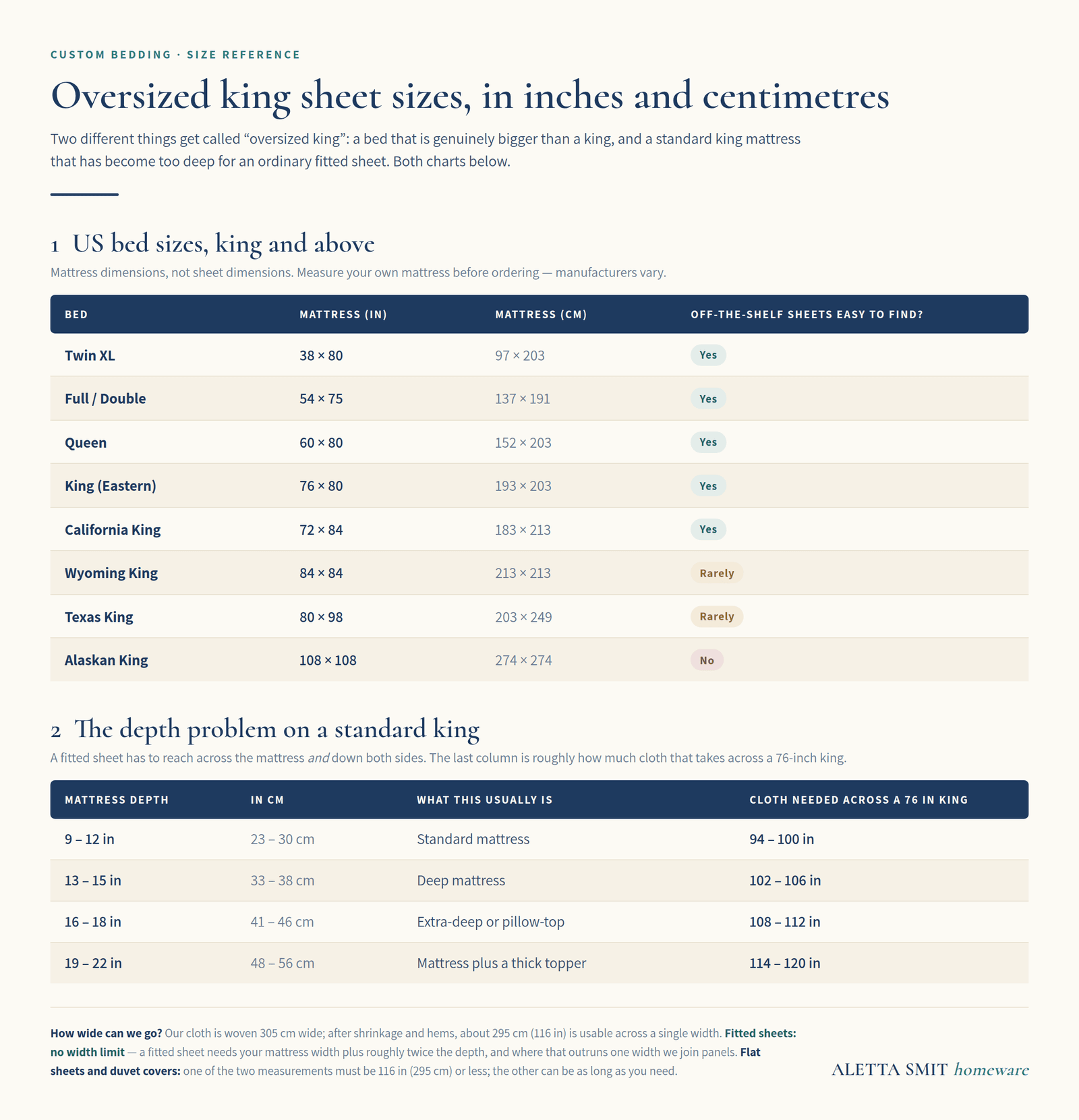
A few notes on the chart. “Alaskan king” (around 108 × 108 in) is what the trade calls the largest bed in this family; even specialist shops rarely carry sheets that size, which is exactly the sort of bed a made-to-measure sheet exists for. And the second half of the chart is the one worth studying if your bed is a normal king: it shows roughly how much fabric a fitted sheet has to span once you account for the depth of the mattress. A 76-inch king at 12 inches deep already needs about 100 inches of cloth across; add a thick topper and you are past what a “king” sheet was ever cut to cover.
The edge cases people assume nobody handles
- A split king. Two separate mattresses on an adjustable base, each usually 38 × 80 in. You need a fitted sheet made for each half, not one king sheet — we make them to those exact dimensions.
- An extra-deep or high mattress. There is no depth we cannot fit; the fitted sheet is cut to the height you enter and finished with full-perimeter elastic so it wraps deep and high mattresses without pulling off.
- A boat berth, caravan bunk or cut corner. Non-rectangular mattresses are the whole reason custom exists. Send us a sketch and we price the exact shape.
How to measure — three numbers, and the one rule that trips people up
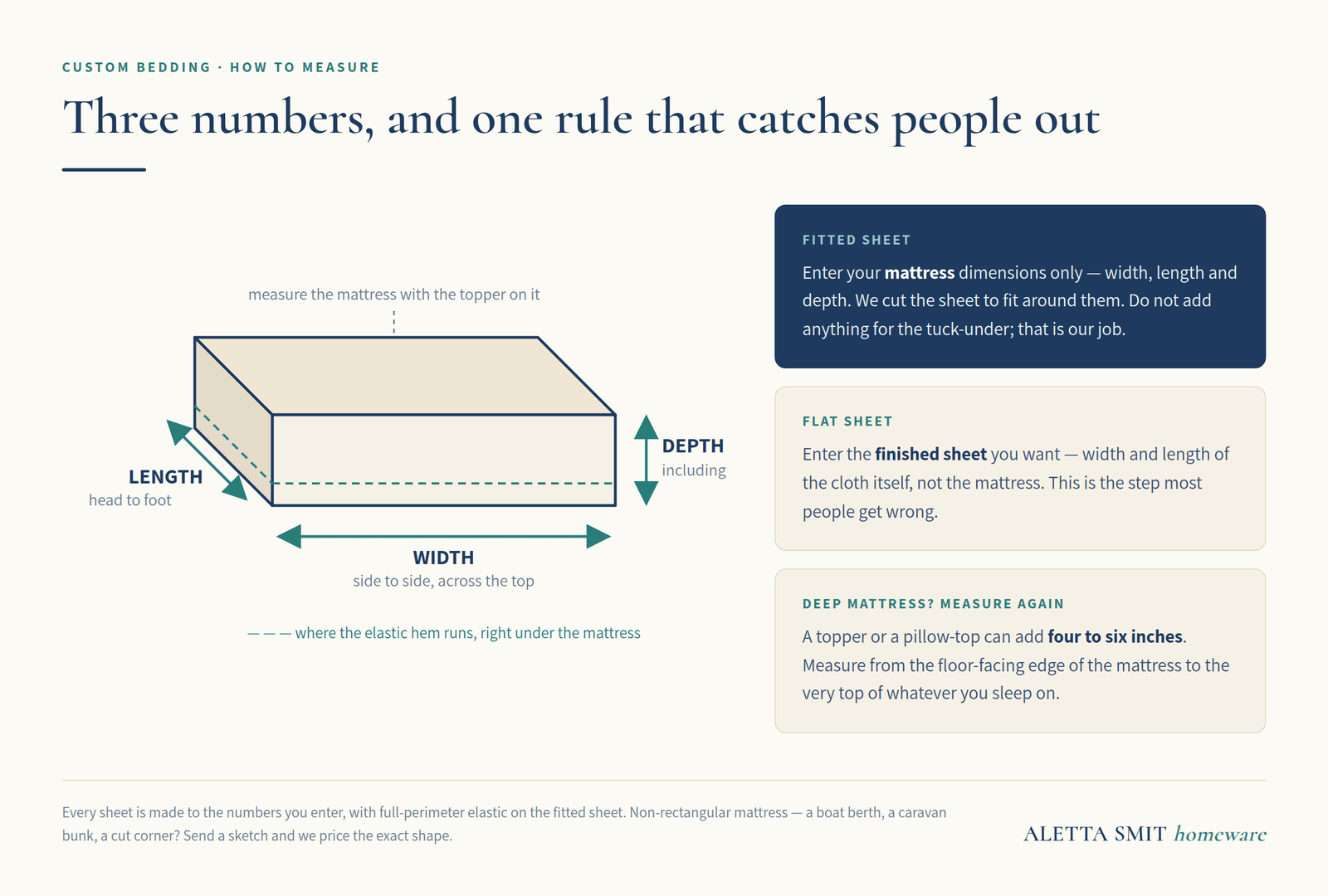
For a fitted sheet, measure your mattress and enter those three numbers only — width, length and depth. We cut the sheet to fit around them; you do not add anything for the tuck-under, because that is our job. For a flat (top) sheet, do the opposite: enter the finished width and length of the sheet you want, not the mattress. That single distinction is the step most people get wrong.
If your mattress has a topper or a pillow-top, measure it with the topper in place — from the floor-facing edge of the mattress to the very top of whatever you actually sleep on. A topper can add four to six inches of depth, and that is exactly the gap a standard sheet cannot close.
How wide can a sheet actually be made?
Our cloth is woven 305 cm wide, and after allowing for shrinkage in the wash and for hems, about 295 cm — roughly 116 inches — is usable across a single width. What happens beyond that depends on which sheet you are ordering.
A fitted sheet has no width limit. A fitted sheet also has to wrap down and under both sides, so its cut width is your mattress width plus roughly twice the depth — which is how even a moderately wide bed can outrun a single width of cloth. When that happens we join panels, so there is no bed too wide for a fitted sheet.
A flat sheet is capped at 116 inches on one side. Flat sheets are made from a single width of cloth, so one of your two measurements has to be 116 inches (295 cm) or less; the other can be as long as you reasonably need. A flat sheet of 116 × 130 inches is fine, 120 × 120 is not. Duvet covers follow the same rule. In a made-to-measure sheet set, that means the fitted sheet follows the first rule and the flat sheet this one — so on a very wide bed you can have a fitted sheet in any width, with a flat sheet up to 116 inches across. Flat sheets have their own size guide, with the full chart and the arithmetic: oversized king flat sheet sizes.
If you are anywhere near those numbers, send us the measurements and we will confirm the exact make before anything is cut.
Which fabric, and why it matters on a big bed
Every sheet is made in your choice of cotton percale or cotton sateen. Percale is crisp, cool and lightweight with a matte finish; sateen is silky, lustrous and softer, with more drape. Both come in a range of thread counts — Percale from 200 up to 800 TC, Sateen from 300 up to 1000 TC — so you can match the weave and weight to how you sleep.
Every fabric in the range, apart from Percale 200 TC, is woven and dyed in Italy and tested for shrinkage, colourfastness and consistency, and the cottons are OEKO-TEX® certified — tested for harmful substances. On an oversized bed that consistency matters more, not less: there is simply more fabric on show, and more of it to keep its colour and its fit wash after wash.
Made to your bed, priced on the spot
The barrier to a custom order is usually the fear of getting the measurements wrong, not the price — so there is no quote to request and no waiting. Enter your dimensions, choose your fabric and colour, and the price updates instantly online. You can order a custom fitted sheet on its own, or a full made-to-measure sheet set — one fitted sheet, one flat sheet and two reversible pillowcases, made to the numbers you enter. If you would rather start from a size page, our oversized bed sheets collection is the place to begin.
Frequently asked questions
Do oversized king sheets actually exist, or do I have to go custom?
Some retailers stock a limited “oversized king” range, usually cut for one specific depth. If your bed is a Wyoming, Texas or Alaskan king, or a standard king made deep by a topper, a made-to-measure sheet is the only way to get a fit that stays put — because it is cut to your numbers rather than an average.
How do I measure mattress depth for a fitted sheet?
Measure from the bottom edge of the mattress (the side facing the base) up to the very top surface, including any topper or pillow-top. Enter that as the depth and the sheet is made to wrap fully underneath.
What is the difference between a Wyoming, Texas and Alaskan king?
Broadly: a Wyoming king is a large square bed (about 84 × 84 in), a Texas king is longer (about 80 × 98 in), and an Alaskan king is the largest square size in the family (about 108 × 108 in). Always measure your own mattress — these figures are industry conventions, not guarantees.
Will a custom sheet fit a mattress with a thick topper?
Yes. Measure the mattress with the topper on it and enter the combined depth. Full-perimeter elastic keeps the sheet on deep and high mattresses without the corners lifting.
I have a split king on an adjustable base — what do I order?
A split king is two separate mattresses, so you order a fitted sheet made to each half’s measurements. Enter the width, length and depth of one mattress and we make it to fit.
Can you make sheets for an Alaskan king?
The fitted sheet, yes — at that width we join panels, so the size itself is not a barrier. The flat sheet is cut from a single width of cloth, so one of its sides has to be 116 inches (295 cm) or less; on a bed that large, a flat sheet with a full drop on both sides may fall outside what we can make. Send us the measurements and we will tell you before you order.
Still deciding on the weave? Our guide to percale versus cotton sateen walks through the feel of each. Shopping for the duvet cover too? See oversized king duvet cover sizes in inches. And if your “bed” is actually a motorhome or caravan, start with custom RV bedding.